By late July 2026, Pennsylvania American Water had finished canvassing Norristown Borough, East Norriton and West Norriton to learn what its customers’ service lines are made of, and about 9,300 customer lines in the Norristown area were still unidentified. That survey matters to anyone planning new water pipes, because the line it is trying to identify is the one an interior repipe connects to.
Philadelphia Freedom Repipe plans and manages whole-house repiping, galvanized pipe replacement and multi-unit repiping for Norristown houses and duplexes. Licensed and insured contractors carry out the work, and each township or borough’s own permit and contractor rules apply. In Norristown that means a municipal contractor license, the statewide plumbing code and a water company with its own replacement terms.
Service lines, interiors and the line between them
Pennsylvania American Water serves more than 30,000 customers in 11 municipalities through its Norristown system, including Norristown, Bridgeport, East and West Norriton, Plymouth and Upper Merion. The company owns the service line from the main to the curb stop. The owner owns everything from the curb stop into the building, and then the interior piping from the meter to every fixture.
A whole-house repipe replaces that interior system; a partial repipe replaces a defined part, such as the runs to one bath, and leaves the rest in service. In a duplex, each unit’s branches are counted and traced, because a shared, unlabeled supply is the usual reason one repair turns into a building-wide shutdown. Drains and sewer pipes are a separate system with separate work, which the guide to whether repiping includes drains explains.
How the job is laid out in a Norristown rowhouse
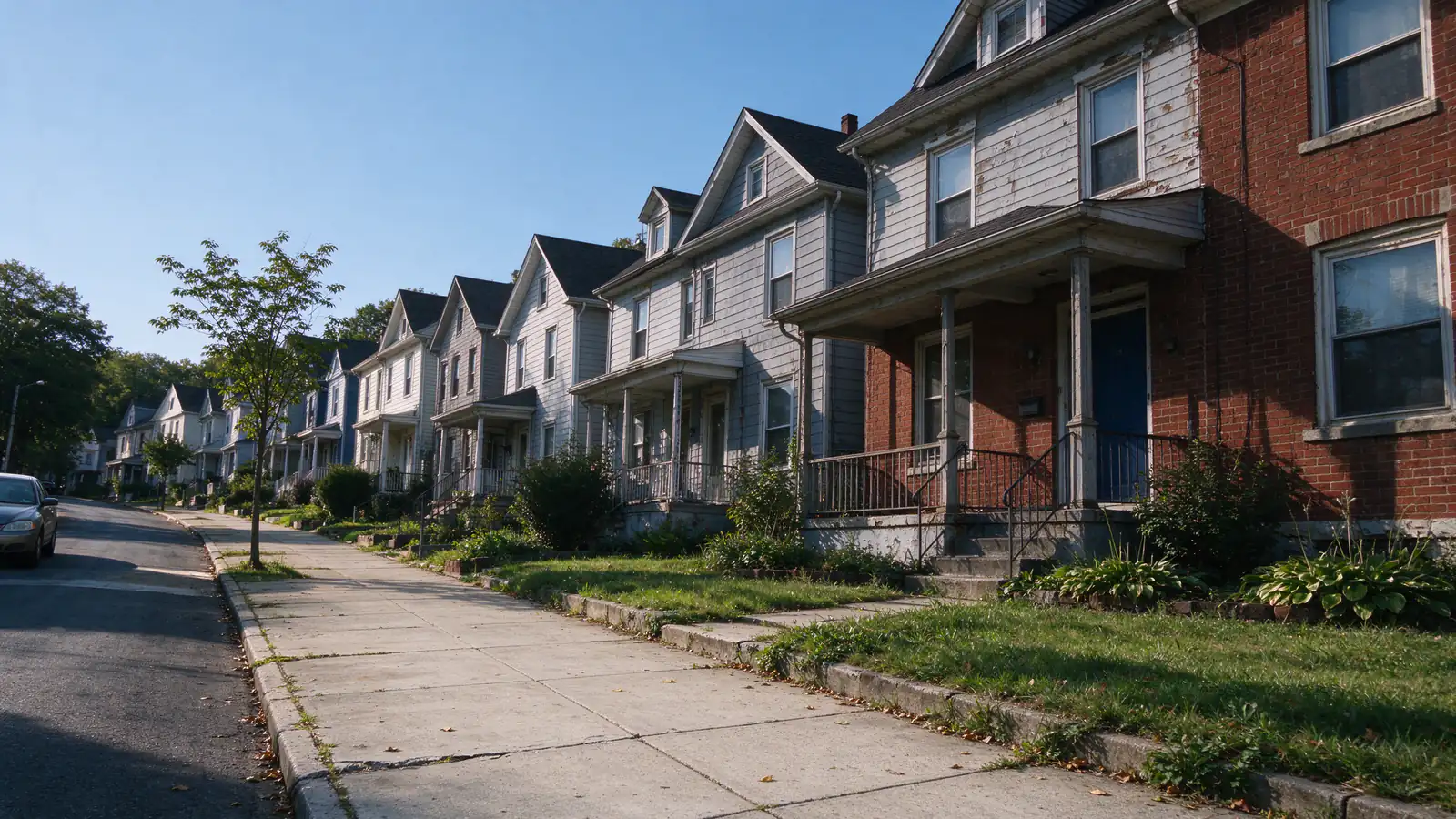
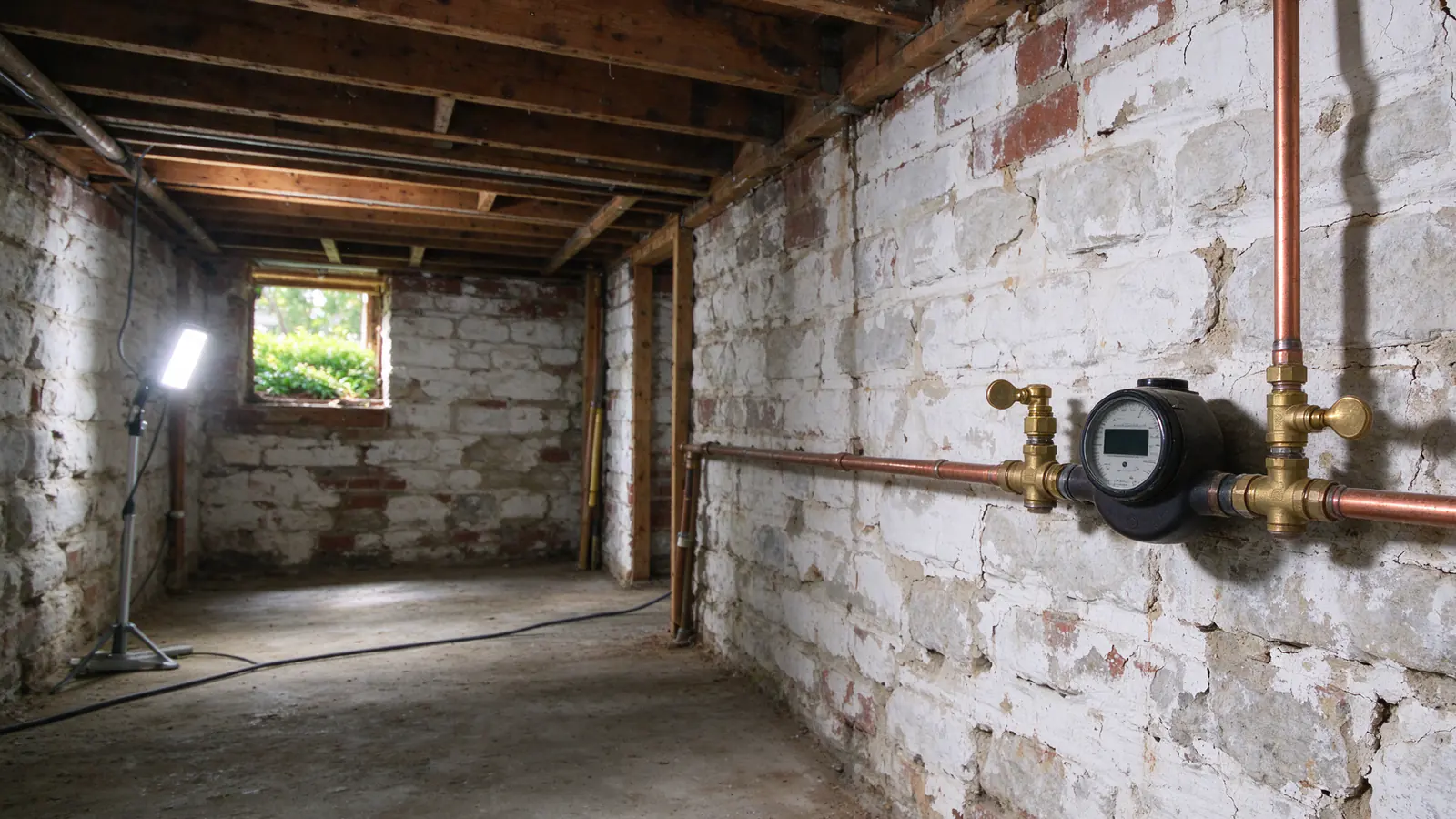
Nearly half of Norristown’s homes are attached, so a common layout starts with the line entering through the front or side foundation wall and meeting the meter in the basement. The first visit begins there: the service line’s material is noted for the water company, the main shutoff is tested, and static pressure and flow are read at the lowest and highest fixtures. A large loss between floors suggests restricted interior pipe; weak flow at the basement tap suggests a supply problem.
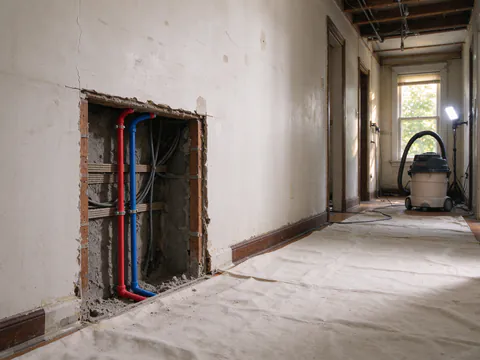
Where a lot is steep, the basement wall the line enters may be partly above grade, which changes where new pipe can run. The route is mapped through closets and stair walls, openings are marked, and the written scope lists each opening and who closes it. After the municipal permit is filed by a properly licensed contractor, new pipe goes in while the old system stays live where possible, and the new system is pressure-tested and flushed before walls close. Shutoffs are labeled, and the municipality’s inspection follows.
Pennsylvania American Water’s replacement terms
Pennsylvania American Water says it replaces customer-owned lead or galvanized steel service lines at no direct cost. Its July 2026 announcement set out identification outreach across the Norristown area, since a line has to be identified before a replacement can be scheduled. The backdrop is federal: the EPA’s Lead and Copper Rule Improvements, issued in October 2024, require water systems to identify and replace lead pipes within 10 years. The company decides which lines qualify and when the work happens, and the identification outreach release is the source to check.
For a repipe, that means the service line usually stays out of the quote. If the line is lead or galvanized and the company will replace it, the interior work is planned to tie in at the meter after or around that replacement. If the line is copper or plastic, the repipe starts at the meter as usual. The guide to identifying your water pipes shows how to check the line at the wall.
Planning new water pipes in Norristown?
Get an interior scope that ties in at the meter and leaves the service line to Pennsylvania American Water where its program applies.
A municipal license, not just HIC registration
The Municipality of Norristown keeps its own list of licensed contractors and states that its license should not be confused with Pennsylvania’s Home Improvement Contractor registration. Its Residential Contractor license covers plumbing on single-family dwellings and duplexes; a Master Plumber license covers non-residential work. A contractor registered with the state but missing the municipal license is not on that list.
The code is the same statewide code used across the suburbs. Pennsylvania’s Uniform Construction Code adopted the 2021 International Plumbing Code in its entirety, effective January 1, 2026, and Philadelphia’s local amendments, such as its metallic-pipe rule for shops, do not apply here. The PEX versus copper guide explains how the material choice is made on its merits.
Attached houses at near-city levels
By the Census Bureau’s American Community Survey, 47.1% of Norristown’s 13,861 homes are single-family attached and 15.9% sit in buildings of two to four units, against 20.1% attached across Montgomery County. Some 32.9% were built before 1940 and 55.4% before 1960, with a median build year of 1957, much older than the county’s 1971. Owner occupancy is 42.7%, so many homes are lived in by people who do not own them, and the permit route depends on who the owner hires.
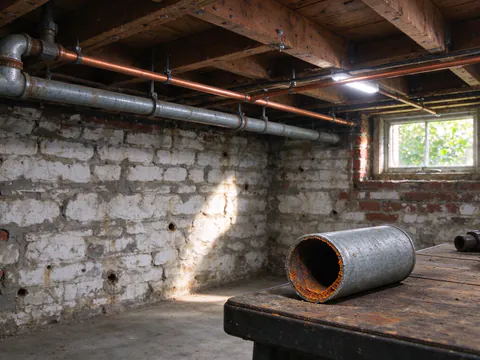
Those figures are context, not proof of what is in any wall. A pre-war house may hold galvanized steel, early copper or pipe replaced decades ago. Discolored water is a clue rather than a verdict, and the rusty water guide separates the common causes. Where a house has plaster walls, openings are made differently, as the guide to repiping plaster walls explains.
How the plan follows from the utility
Pennsylvania American Water’s role sets the boundary of the job: it owns part of the service line and may replace the owner’s part, which keeps that work out of the repipe price. Norristown’s own license list is the second check, since it is separate from state registration. In a duplex, each unit is traced and valved on its own, because the people living in one unit should not lose water while the other is worked on, and because a labeled shutoff per unit makes every later repair smaller. New interior pipe will not cure low pressure that starts at the street, so flow is tested before a whole-house scope is written. The repiping cost guide shows how fixtures, floors, materials and patching set a price within the range.