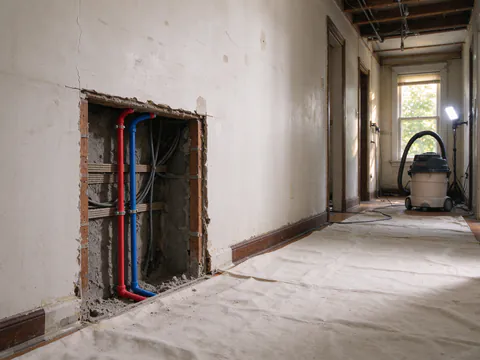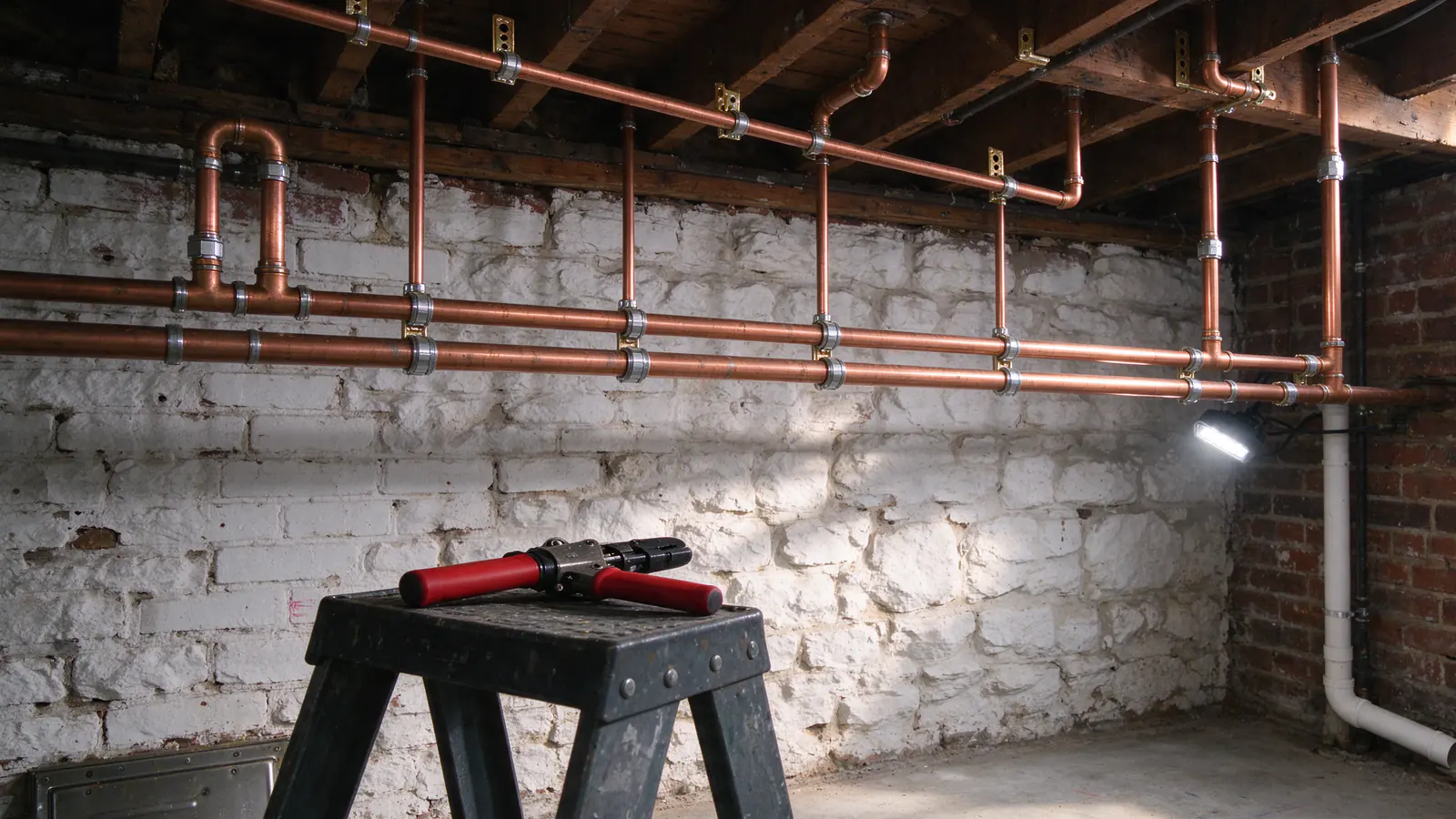
A whole-house repipe of a single-family house or rowhouse in the Philadelphia area typically costs $4,000 to $15,000+, and larger homes and copper jobs can pass $20,000. A repipe in PEX runs about $4,000 to $10,000 for a typical home. These are planning ranges, not quotes; the price for a specific house comes after someone has walked it from the meter up.
Philadelphia Freedom Repipe offers and manages whole-house repiping across Philadelphia and nearby Delaware, Montgomery and Bucks County suburbs, carried out by licensed and insured contractors. This guide explains what sits inside those ranges, which parts have a public figure you can check, and which parts only a walk-through can price.
Typical ranges around Philadelphia
| Work | Typical range | What the range covers |
|---|---|---|
| Whole-house repipe, single-family house or rowhouse | $4,000 to $15,000+ | Hot and cold supply piping from the main shutoff to the fixtures, in PEX or copper. Larger homes and copper jobs can pass $20,000. |
| PEX whole-house repipe | About $4,000 to $10,000 | A typical home repiped in PEX across the Philadelphia area. Large homes run higher. |
| Partial repipe | No published range | One floor, one riser or one fixture group, priced from the scope. See partial repiping. |
The top of the whole-house range is open on purpose. A three-story twin with plaster on every floor and two tiled bathrooms is a different job from a two-story rowhouse with open basement joists, even with a similar fixture count. Copper costs more than PEX as pipe, and it is the material the code requires for some buildings, which is one reason the copper jobs sit higher.
What moves a repipe price in Philadelphia
| Factor | How it plays out in a Philadelphia house |
|---|---|
| House size and stories | Each floor adds riser length and another set of openings. By Census figures, 55.6% of the city’s housing units are single-family attached homes, rowhouses and twins. |
| Fixture count | Every sink, tub, toilet, laundry box and hose bibb is a branch to run and a connection to make. It also sets the L&I permit fee past the first 7 fixtures. |
| Pipe material | PEX is allowed in one- and two-family dwellings and apartments; metallic pipe is required in other occupancies. See PEX vs copper for a repipe. |
| Layout and party walls | Pipe may not cross into the house next door, so every riser has to rise through the house’s own walls, closets or chases. |
| Basement, crawlspace and attic access | Open basement joists keep the mains out of finished walls. A rear addition over a crawlspace or a third-floor bathroom under the roof adds harder runs. |
| Plaster, tile and cabinets | Plaster on lath, tiled showers and built-in cabinets take more time to open around and more to close. See repiping plaster walls. |
| Number of openings and patch scope | Rough patch, finished plaster and paint are three different prices. |
| Manifold or trunk-and-branch layout | A manifold means more lines but a shutoff for each fixture; trunk-and-branch means fewer, larger lines. |
| Valves and pressure control | A seized main shutoff adds parts and labor at the start of the system. Where a pressure-reducing valve or check valve is on the supply, thermal expansion control is required. |
| Water heater connections | Philadelphia’s EZ permit standards call for at least 4 feet of copper or similar metallic pipe at the heater’s inlet and outlet. |
| People living in the house | Staging water-off windows around the people living there adds cutovers and days. |
| Old painted plaster | Cutting painted surfaces in a house built before 1978 brings EPA lead-safe work practices into the job. |
What’s inside a Philadelphia repipe price
Some parts of a repipe have a public figure behind them. Others have none, and those are the ones to pin down in writing.
| Part of the price | What sets it | Local public figure |
|---|---|---|
| Labor | Hours on site, set by fixtures, floors and access | Plumbers in the Philadelphia-Camden-Wilmington metro area earn a median $35.99 an hour against $30.67 nationally, about 17% higher (BLS, Philadelphia metro; BLS, national) |
| City permit | Fixture count and building type | Alterations, one- or two-family dwelling: $50 for the first 7 fixtures, $22.50 each after. Other occupancies: $189 for the first 7, $22.50 each after. Plus a $100 filing fee applied toward the final fee, a $3 city surcharge, a $4.50 state surcharge and $4 per plan for record retention (L&I fee summary) |
| Pipe and fittings | The material the code allows for the building | PEX or copper in one- and two-family dwellings and apartments; metallic pipe in any other occupancy under P-605.4 (L&I code amendments summary). No public material price index was found for local use |
| Plaster, tile and finish restoration | Number of openings, plaster or drywall, paint | No public figure. Scope to check on the quote |
| Water heater connections | The metallic section at the inlet and outlet, and expansion control | No public figure. Scope to check on the quote |
A wage is not a billing rate. The rate a contractor charges also carries insurance, licensing, vehicles, tools, permit time and overhead, so a billed hourly rate cannot be compared with these wages. The gap between the local and national medians is still the clearest public reason a Philadelphia repipe costs more than a national average suggests. Which L&I fee line applies to a given repipe, alteration or repair and replacement, is L&I’s call, and the Philadelphia repipe permit guide covers the application.
Want a number for your house?
A walk-through from the meter turns these ranges into a written scope and price.
Illustrative budgets
These examples are illustrative only. They show how the published ranges and fees combine; they are not quotes and do not describe real jobs.
Illustrative: a two-story rowhouse in PEX, one bathroom upstairs, kitchen and basement laundry. Seven fixtures or fewer: kitchen sink, dishwasher, toilet, bathroom sink, tub, washer and a hose bibb. The repipe would fall in the PEX range of about $4,000 to $10,000, toward the lower part if the basement joists are open and the bathroom sits over the kitchen. Permit: $50 for the first 7 fixtures, with the $100 filing fee and surcharges. Restoration: priced on the quote.
Illustrative: a three-story twin with two bathrooms and plaster on every floor. The whole-house range of $4,000 to $15,000+ applies, with three floors of plaster pushing it toward the top or past it, and further still in copper. Permit: $50 for the first 7 fixtures and $22.50 for each fixture beyond that.
Illustrative: a corner property with a store on the ground floor and an apartment above. No published range covers it. The commercial space needs metallic pipe under the Philadelphia code, and the permit falls in L&I’s other-occupancy column: $189 for the first 7 fixtures and $22.50 each after. Store hours set when walls can open.
What a repipe price does not include
The water service line. A repipe starts at the main shutoff inside the house. In Philadelphia the owner owns the service line from the ferrule at the water main to the house, and replacing it is separate work with its own permits. The Philadelphia Water Department puts replacing a lead service line with a private plumber at $3,000 to $12,000, and more when a street opening is needed. The lead service line replacement cost guide covers that side.
Drains, vents and the sewer lateral. A repipe replaces pressurized supply pipe only. Drain work is a separate scope, and the guide to whether repiping includes drains explains where the line falls.
Reading a quote line by line
Two quotes for the same rowhouse can differ by thousands because they describe different jobs. Check whether each one names the pipe material, lists every fixture connection, includes the main shutoff and any expansion control, includes the L&I permit and who pulls it, lists the wall openings and who closes them, and says when the water will be off. The guide to old water pipes in Philadelphia homes covers whether the house needs a repipe at all, and the repipe cost estimator works from the same published ranges.