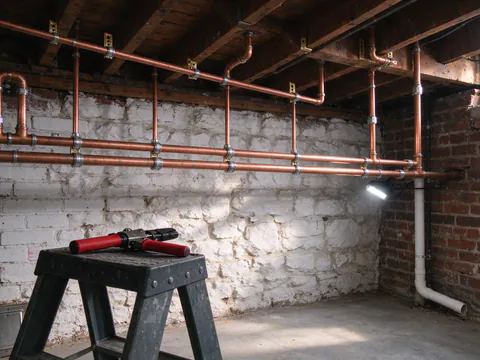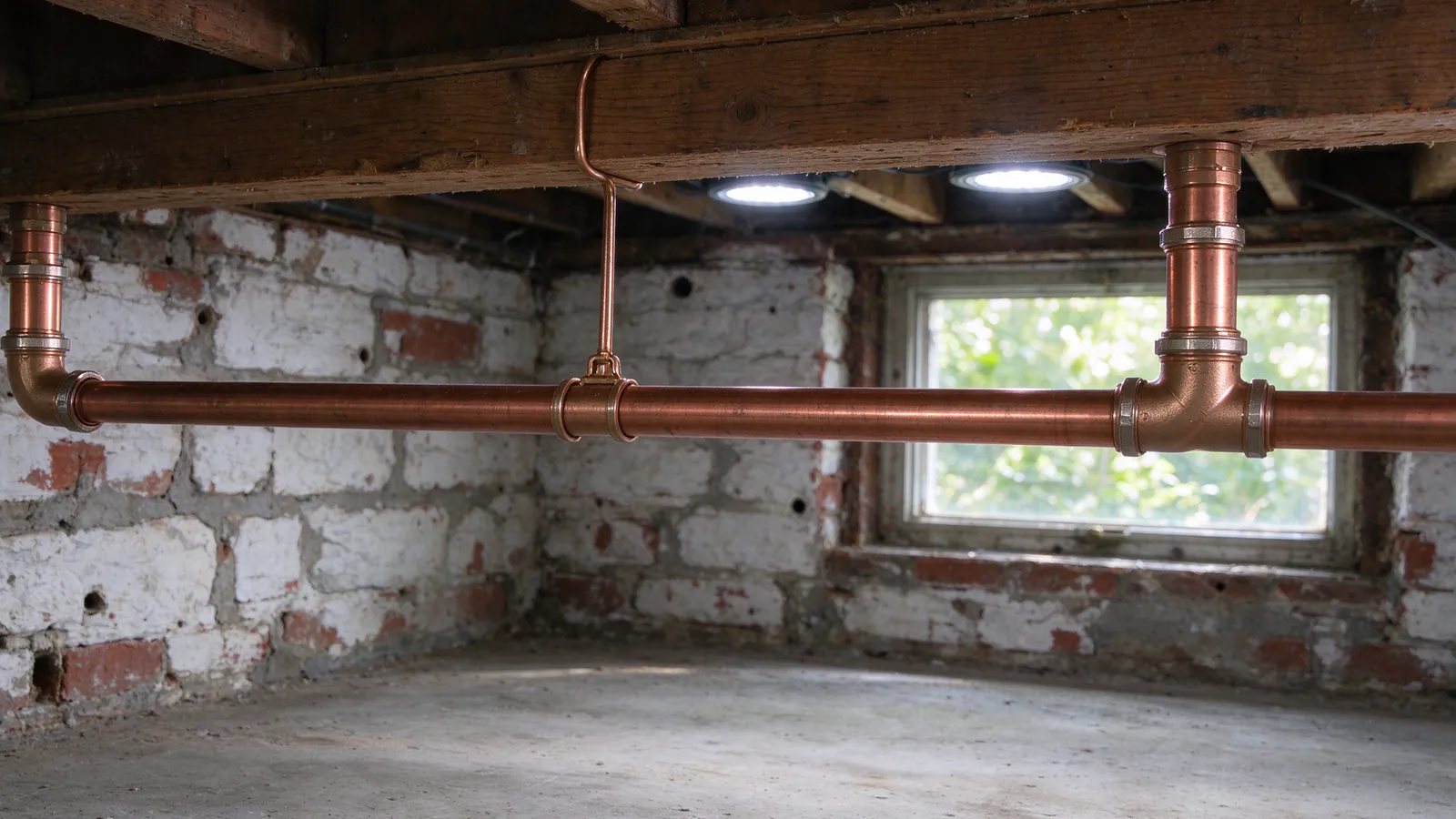
Neither material is better for every house. PEX is flexible, needs fewer joints and is easier to fish through plaster walls, so it usually costs less to install. Copper is rigid, handles heat, resists rodents and is required in some Philadelphia buildings. The right choice comes from the building type, its walls, its basement and the budget.
Philadelphia Freedom Repipe offers and manages PEX repiping and copper repiping across Philadelphia and nearby Delaware, Montgomery and Bucks County suburbs, carried out by licensed and insured contractors. This guide compares the two on the points that actually decide a Philadelphia job, in roughly the order they come up during a walk-through.
Start with what the code allows
In Philadelphia, the building decides before the homeowner does. Under section P-605.4 of the Philadelphia Plumbing Code, water supply piping must be metallic in any occupancy other than one- and two-family dwellings and apartments, and in buildings with an occupied floor more than 75 feet above fire-access level. A rowhouse, twin or apartment can be piped in PEX or copper. A corner store, an office or the commercial floor of a mixed-use building needs metal, which usually means copper.
Even in a house, a PEX system is not all plastic. L&I’s EZ permit standards require at least 4 feet of copper or similar metallic pipe at the water heater’s inlet and outlet. The is PEX allowed in Philadelphia guide covers the rule in full, including the pending code bill and the suburbs, where the statewide code applies.
How the two compare
| Factor | PEX | Copper |
|---|---|---|
| Philadelphia code | Allowed in one- and two-family dwellings and apartments | Allowed everywhere; required in other occupancies |
| Joints | Fewer; long runs bend around corners | More; every change of direction is a fitting |
| Getting through finished walls | Can be fished through plaster and around obstacles | Needs straight access for rigid lengths and room to join them |
| Heat | Kept away from the heater by the required copper section | Tolerates heat at the heater and near flues |
| Freezing | Can stretch slightly; fittings remain a weak point | Tends to split when water freezes inside |
| Rodents | Can be gnawed | Resists gnawing |
| Sunlight | Must be kept out of UV light | Not affected |
| Typical cost direction | Usually lower to install | Usually higher in material and labor |
Two points sit behind that table. First, joints are where most failures start, in any material, so a system with fewer joints has fewer places to go wrong. Second, the differences in the table only matter if the installation is right: PEX needs proper support, bend radius and listed fittings, and copper needs clean cuts, reamed ends and well-made joints. A good installation of either outlasts a poor installation of the other.
Philadelphia water and each material
Water chemistry affects metal pipe much more than plastic. The Philadelphia Water Department adds zinc orthophosphate to its treated water, which forms a protective coating inside pipes, and has done so for decades. In PWD’s 2025 Lead and Copper Rule testing at 106 homes, the 90th-percentile copper result was 0.210 parts per million, and none of the 106 was above the 1.3 ppm action level, according to the 2025 drinking water quality report.
Hardness varies by treatment plant. PWD’s 2025 report puts the yearly average at 101 ppm for the Baxter plant on the Delaware, 151 ppm for Belmont and 169 ppm for Queen Lane on the Schuylkill, and describes the water as moderately hard or hard depending on the area. Chloride levels vary too, and some neighborhoods get a mix from more than one plant.
What that means for the choice: Philadelphia water is not known as hostile to copper, and the city’s corrosion control works in copper’s favor. It does not make copper immune. Pinhole leaks have several possible causes, from velocity to workmanship, as the copper pinhole leaks guide explains. PEX does not corrode, but it is exposed to the disinfectant in treated water, which is why PEX tubing carries a chlorine-resistance rating printed on it.
Cold basements and freezing
Philadelphia winters are not extreme, but they freeze. NOAA’s 1991 to 2020 normals for Philadelphia International Airport show 77.3 days a year with a low at or below freezing and 13.1 days when the temperature never rises above it. Pipes freeze where cold air reaches them: a front wall in an unheated basement, a rear kitchen over a crawlspace, a run beside a leaky window or a hose bibb line.
PEX can expand slightly as water freezes inside it and often survives a freeze that would split copper. That is an advantage, not a guarantee. Fittings can still crack, and a frozen line delivers no water either way. New material alone does not remove freeze exposure; routing pipe inside the heated part of the house, sealing air leaks and insulating runs near outside walls do. The frozen pipes in a Philadelphia rowhouse post covers the cold spots in more detail.
Rodents
Homeowners ask whether rats chew PEX, and the honest answer is that they can. Rodents gnaw to wear down their teeth and will work on plastic pipe, wire insulation and soft building materials. Copper resists that. In a basement with a known rodent problem, PEX runs can be kept inside joist bays, protected where they cross open areas or sleeved at penetrations, and the rodents themselves need attention because they put the wiring at risk too. In a house without that problem, rodents are rarely the deciding factor.
Walls, access and the price
The material changes the number of openings more than people expect. In a Philadelphia rowhouse the supply usually runs along the basement ceiling, rises through a closet or stair wall and crosses to a bathroom at the back of the second floor. PEX can often be fished up a cavity and around framing from a few openings. Copper comes in rigid lengths and every turn needs a fitting, so it usually needs more or larger access to make the joints. In houses with plaster on lath, each extra opening adds patching time; the repiping plaster walls guide explains why.
On price, the direction is consistent even though no separate public range exists for copper. A whole-house repipe of a single-family house or rowhouse in the Philadelphia area typically costs $4,000 to $15,000+, and larger homes and copper jobs can pass $20,000. A PEX whole-house repipe runs about $4,000 to $10,000 for a typical home. Copper costs more as pipe and takes longer to install, which is why copper jobs sit toward the top of the wider range. The Philadelphia repiping cost guide breaks down the other drivers.
A sensible way to decide
Start with the building: if any part is commercial or the building is tall, that part needs metal. Then look at the house. Heavy plaster and tight cavities favor PEX. A basement with rodent trouble, or exposed runs near heat, favors copper or protected PEX. Budget pushes toward PEX; a preference for metal throughout pushes toward copper, at a higher cost. Some houses use both, with copper where it is required or exposed and PEX in the walls.
Philadelphia Freedom Repipe replaces supply piping in either material, and the walk-through from the meter is where the choice is made, with the reasons written into the scope. The old water pipes guide explains what is likely being replaced, and the whole-house repiping page shows how the job runs from start to finish.