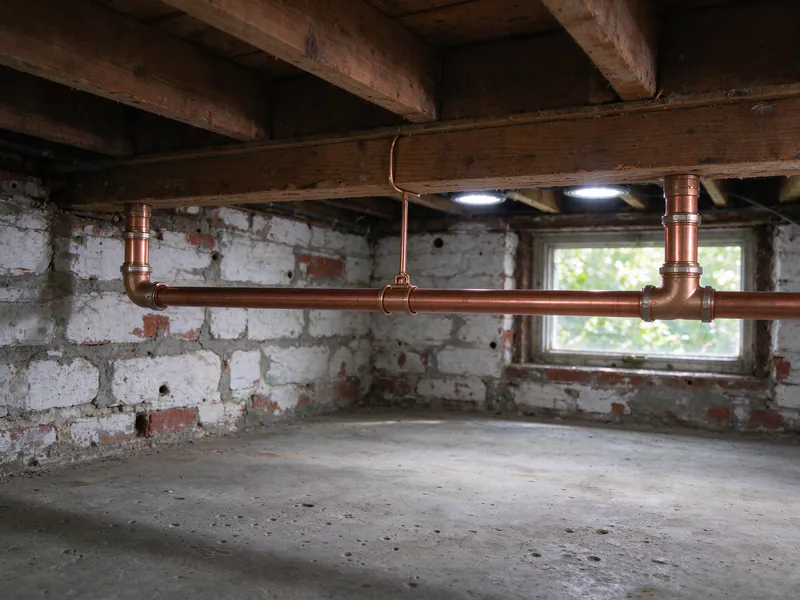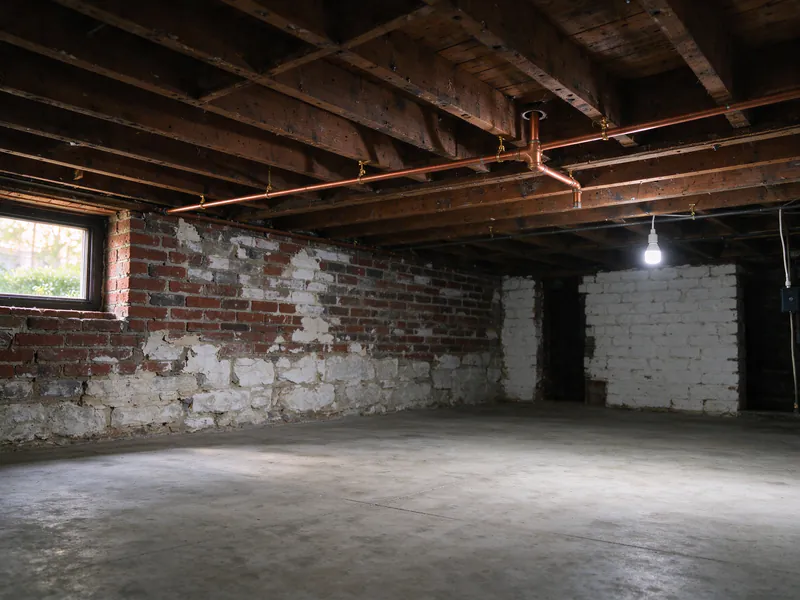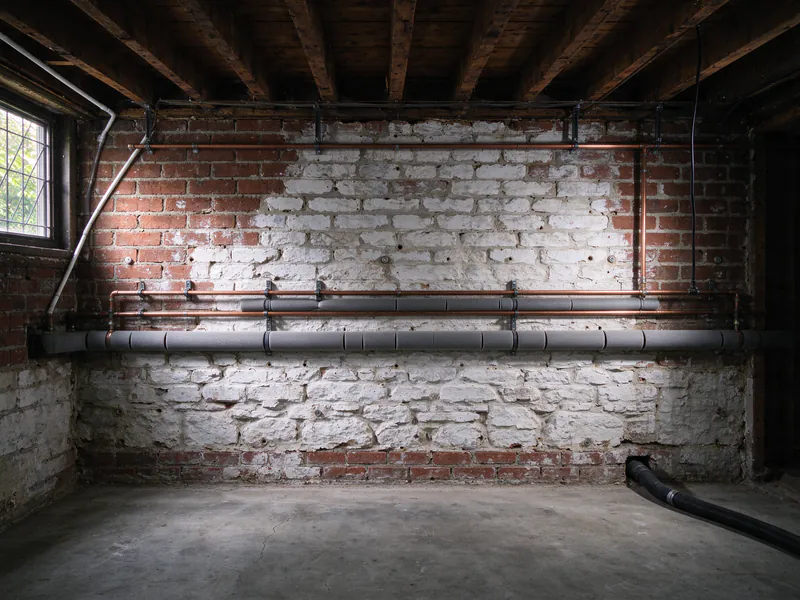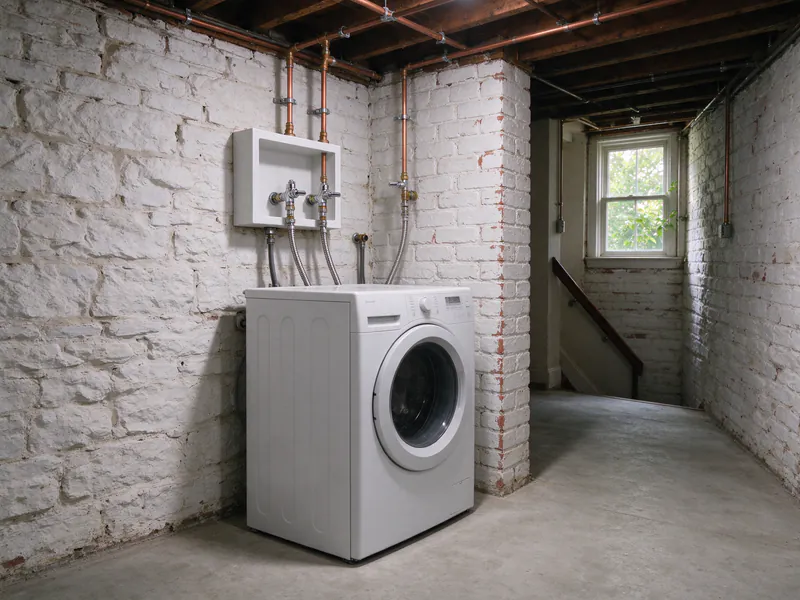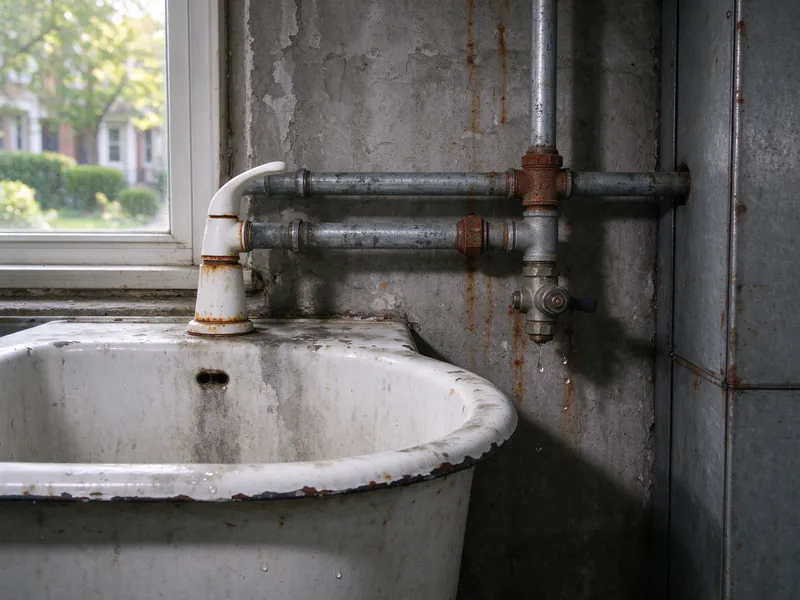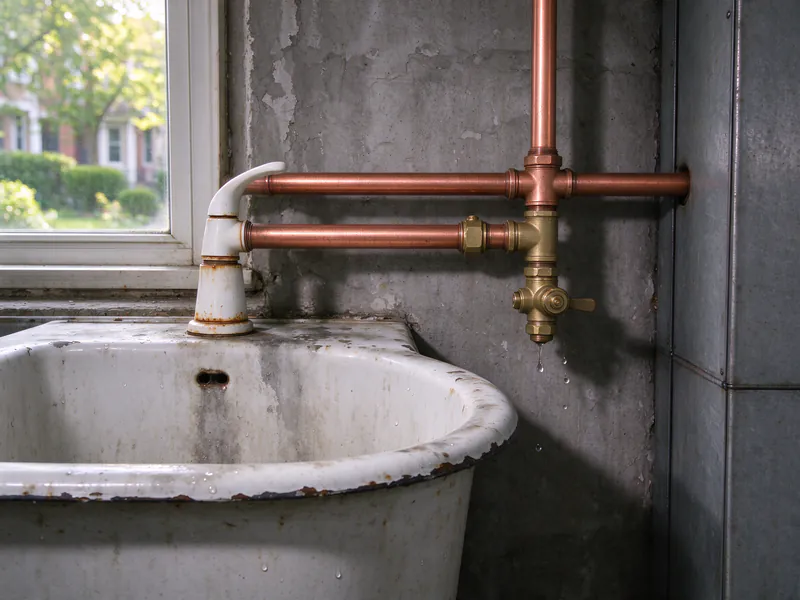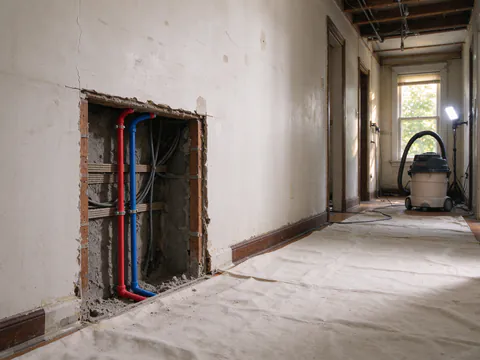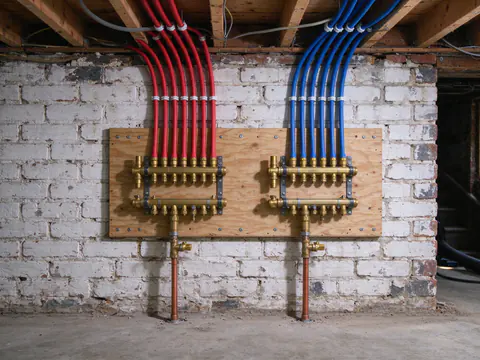
Philadelphia Freedom Repipe repipes buildings in copper across Philadelphia and nearby Delaware, Montgomery and Bucks County suburbs. In a Philadelphia house, copper is a choice. In a corner property with a shop downstairs, an office conversion or any building outside the dwelling and apartment categories, the City code makes metal pipe a requirement. Either way, copper brings decisions that PEX does not: which tube type, press or solder at each joint, how to work with a flame inside a century-old frame, and how the local water treats the metal. Licensed and insured contractors carry out the work; inside the city, a Philadelphia licensed master plumber oversees the job and pulls the L&I permit.
Most Philadelphia house repipes are PEX, which the PEX repiping page covers. This page is about the buildings and owners for which copper is the answer, and the PEX vs copper repipe guide sets the two side by side.
When metal pipe is required in Philadelphia
The 2018 Philadelphia Plumbing Code, as amended effective April 1, 2024, allows plastic water pipe in one- and two-family dwellings and apartments. Section P-605.4 requires metallic piping for any water supply piping that supplies or is located within any other occupancy, and P-605.3 applies the same rule to the water distribution pipe that brings water into those buildings. L&I-approved scopes for commercial and mixed-use work spell it out: all piping for conveyance and supply for the commercial space shall be metallic.
That matters in a city where corner stores, bars and offices sit in the ground floor of rowhouse blocks. A building with an apartment upstairs and a business at street level needs metal for the commercial side, and the apartment side should be confirmed with L&I before materials are ordered. The commercial repiping page covers scheduling around a business. P-605.4.1 adds a height rule: metallic piping where an occupied floor sits more than 75 feet above the fire-access level, which reaches larger apartment buildings.
A bill to adopt the 2021 International Plumbing Code as Philadelphia’s code, introduced in June 2025, keeps the same metallic-piping text; whether it has been enacted is something to confirm with L&I, which publishes the code in force. Suburban townships enforce the statewide Pennsylvania Uniform Construction Code instead, and each township or borough’s own permit and contractor rules apply.
Type K, L or M
Copper water tube comes in three common wall thicknesses, color-coded on the tube. Type K is the heaviest and is mostly used underground; Philadelphia service line permits name it, such as “3/4 inch K copper”. Type L, a medium wall, is the usual choice for interior distribution. Type M is the thinnest and least costly. A thinner wall leaves less metal between the water and a pinhole, so a quote that just says “copper” leaves out a real difference. Ask which type is priced.
Press or solder
Soldered joints are the traditional method. The tube is cut square, reamed, cleaned, fluxed and heated with a torch until solder draws into the fitting. Done well, a soldered joint lasts as long as the pipe. Done poorly, with flux left inside or a burr left on the cut, it can start erosion downstream. Solder for drinking water must be lead-free; PWD notes that lead can be hidden in older plumbing work, including old solder, which is one more reason old joints are cut out rather than reused.
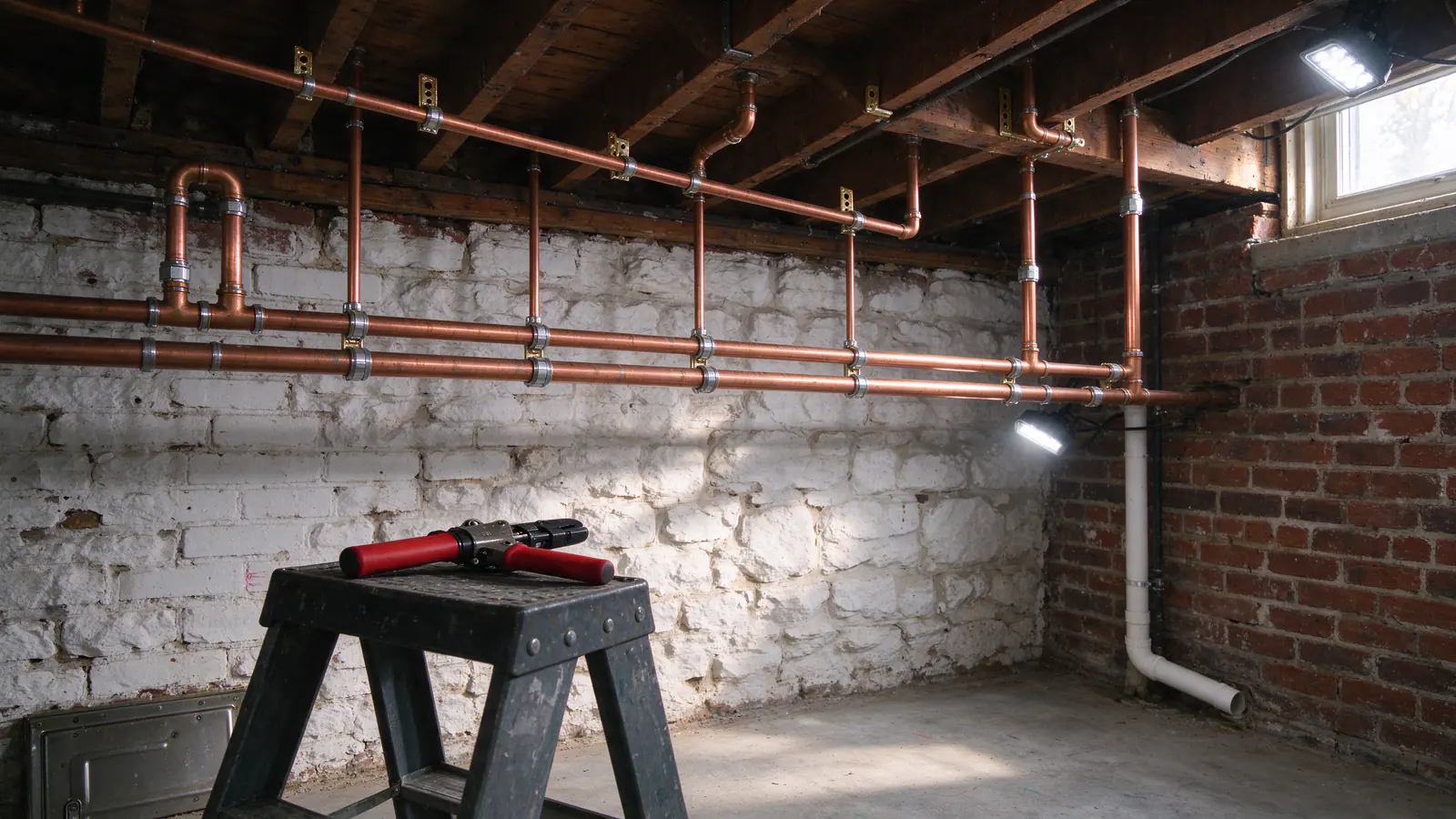
Press fittings carry a sealing O-ring inside the fitting. A battery press tool crimps the fitting onto the tube in seconds, with no flame and no need to drain every drop from the line. They cost more per fitting and need the right tool and jaws for each size. Philadelphia’s code allows press-connect joints above ground only.
Many copper repipes mix the two: press fittings inside finished walls and near framing, solder on open basement runs. The written scope should say which is used where.
Hot work in an old house
Philadelphia rowhouses are full of dry wood. Lath behind plaster, old joists, and in older houses framing with open cavities between floors can carry heat and fire a long way from where the torch is. Any job that solders inside a finished house needs a hot-work plan: a heat shield behind every joint near wood, water and an extinguisher at hand, and a fire watch that stays after the last joint, because smoldering lath can take time to show. Where a joint must be made in a closed cavity, a press fitting removes the flame entirely. This is a real reason press fittings have become common in occupied houses.
Planning copper for a mixed-use building?
The walk-through confirms what the code requires on each floor and how rigid pipe can reach each fixture.
Philadelphia water and copper
Copper’s life depends partly on the water it carries. PWD’s 2025 drinking water quality report puts tap hardness at about 101 ppm (6 grains per gallon) from the Baxter plant on the Delaware, 151 ppm (9 grains) from Belmont and 169 ppm (10 grains) from Queen Lane on the Schuylkill. PWD describes its water as moderately hard or hard, depending on the service area, and some addresses get a mix. Chloride runs higher in the Schuylkill plants’ range than at Baxter.
PWD adds zinc orthophosphate, which forms a protective coating inside pipes. In its 2025 Lead and Copper Rule sampling of 106 homes, the copper 90th percentile was 0.210 ppm and no home was above the 1.3 ppm action level. That says the treatment keeps copper from dissolving into the water in most homes. It does not say copper pipe lasts forever, and it is no promise about any one house.
In Aqua Pennsylvania’s main system, which serves many of the inner suburbs, the water is disinfected with chloramines and the reported copper 90th percentile was 0.34 ppm. Chemistry differs by utility, and a copper decision in Upper Darby or Abington starts with that utility’s report.
Pinholes have more than one cause
A pinhole leak in copper is a small hole worn or corroded through the wall from inside. No single cause explains them, and anyone who names one without looking is guessing. Contributors include water chemistry, high water velocity in undersized pipe or on a recirculation loop, flux residue left inside joints, burrs left on cut ends that create turbulence, and in some cases stray electrical current. Pinholes clustered just downstream of fittings point toward velocity or workmanship. Pinholes spread along straight runs point toward chemistry or the pipe itself. The guide to copper pinhole leaks explains how the pattern is read.
When an older copper system has a pinhole history, the repipe plan sizes the new lines so water moves at a reasonable speed, specifies the tube type, and makes joints so the inside stays clean.
Testing, permit and price
The new copper is pressure tested before any wall closes, then flushed, with each shutoff labeled. Hot lines are insulated where the EZ standards require R-3, and runs near outside walls are insulated against freezing. For occupancies other than one- and two-family dwellings, L&I lists the alteration permit at $189 for the first 7 fixtures and $22.50 for each additional one; a house falls under the $50 column. The Philadelphia repipe permit guide covers the application.
Copper repipes are priced from the scope. Fixture count, floors, occupancy, plaster or tile access, the number of joints and patching all move the number, and on the whole-house range, larger homes and copper jobs can pass $20,000. The repiping cost guide for Philadelphia explains each driver.
Related resources
- Whole-house repiping, the full scope in any material
- Is PEX allowed in Philadelphia? for the occupancy rule in detail
- Galvanized pipe replacement, including copper-to-steel transitions