The easiest time to repipe a rental is between occupants, once the pipe shows it is failing. An empty unit means walls can be opened, water shut off and plaster patched without working around anyone’s day. There is no build year at which the code says a rental must be repiped; condition decides, and a pressure complaint should be diagnosed before anyone sells a repipe as the answer.
Philadelphia Freedom Repipe replaces water supply piping in rented houses and small multi-unit buildings across Philadelphia and nearby Delaware, Montgomery and Bucks County suburbs. This guide is for owners: when to repipe, how to stage the work around the people living there, and what an owner has to handle when the service line is lead. The multi-unit repiping page covers larger buildings in more detail.
Repipe now, or wait for a vacancy?
A complaint about weak water in an occupied unit puts the decision on a deadline. Before committing to a repipe, measure. Static pressure at a test point, and flow at the lowest and highest fixtures with two taps open, separate a building where old galvanized chokes the flow from one where the problem is a half-closed valve, an old globe-style main shutoff, a clogged aerator or the service line from the street. Galvanized steel narrows from the inside as scale builds, so its symptom is often flow that collapses when two fixtures run. None of those readings proves one cause alone, and the low water pressure guide walks through the checks.
If the old pipe is the cause and the problem is confined, a partial repipe of one bathroom group or one riser can restore the unit now, with the rest planned for a vacancy. If the pipe is galvanized throughout and leaking at joints, waiting usually means paying for emergency repairs, water damage below, and openings that get patched twice. A common middle path is to make the next turnover the deadline and fix only what has to be fixed in the meantime.
Why vacancy is the easiest window
In an empty unit, every wall can be opened at once, the water can stay off for as long as the cutover needs, and nobody has to be warned about dust or noise. The job usually runs in fewer stages, with fewer temporary transitions between old and new pipe, and the openings can be closed to the finish the next occupant will see. Repiping before a new lease also means the first service call under the next lease is less likely to be a leak in a ceiling.
In a house with two units, timing the repipe to one vacancy still leaves the other unit occupied. The shared main in the basement and any shared risers have to be cut over with the occupied unit’s water off, so plan those windows with the people living there.
Stack-by-stack staging in a multi-unit building
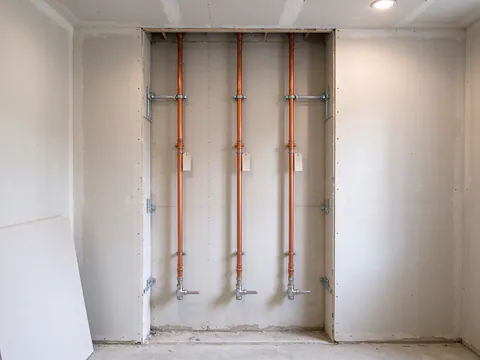
In apartment buildings and converted rowhouses, kitchens and bathrooms are usually stacked above one another, so each stack has its own risers. Repiping one stack at a time keeps the rest of the building in service.
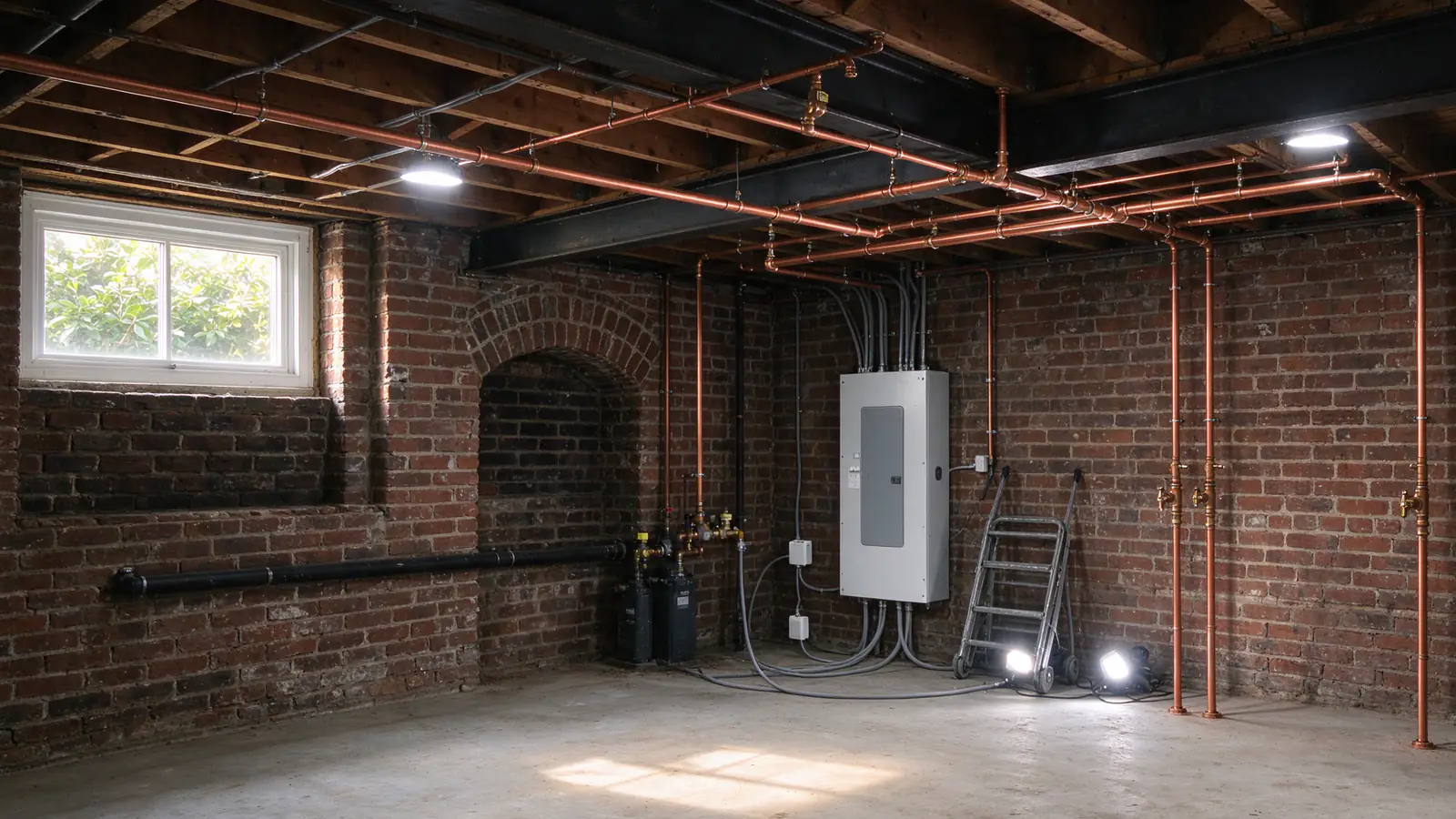
- Map the stacks. The walk-through traces each riser from the basement main and records which units and fixtures it serves, and where earlier spot repairs left mixed materials.
- Run the new stack alongside the old. New risers and branches are installed while the old pipe still supplies the units.
- Cut over one stack. Water to that stack is shut off, the old risers are capped and the new ones connected. Only the units on that stack lose water, during that window.
- Test, then close. Each stack is pressure tested before its openings close, and the lines are flushed after cutover.
Costs come down when the layout repeats. Identical units with walls in the same place on every floor mean openings can be marked once and repeated; hallway closets or a shared chase can carry risers without opening living space. Vacant units in the stack can take the openings for the whole riser. The living through a repipe guide covers what occupied units go through.
Code and permit points for rental buildings
The material rule depends on occupancy. Under the Philadelphia Plumbing Code as amended effective April 1, 2024, PEX and other nonmetallic piping is allowed in one- and two-family dwellings and apartments, while any water supply piping that serves or sits within another occupancy, such as a shop on the ground floor, must be metallic. Metallic piping is also required where an occupied floor is more than 75 feet above fire-access level. The guide to whether PEX is allowed in Philadelphia explains the rule.
The permit fee depends on building type. L&I lists alterations in a one- or two-family dwelling at $50 for the first 7 fixtures and $22.50 for each after; other occupancies, which includes larger apartment buildings, start at $189 for the first 7 fixtures. The EZ permit, with no plans, covers alterations in buildings with four or fewer dwellings up to four stories, so a larger building should expect a fuller application. A licensed master plumber oversees the work in the city.
In the suburbs, the rules can differ for rentals specifically. Upper Darby, for example, lets property owners pull their own plumbing permit only for an owner-occupied primary residence, not rentals or investment property.
Telling residents about the work
People who live in the building need to know what is happening in their unit and when. Give written notice of each water-off window and each day someone needs to be inside, following the lease and the notice rules that apply. Say which walls will be opened, how long they will stay open and how dust will be contained. If a resident relies on water for medical equipment, plan around it. A posted schedule by stack, with a contact for questions, cuts down on surprises.
The service line: what the owner handles
In Philadelphia the property owner owns the entire water service line, including the curb stop. When PWD finds a leaking or defective line it issues a Notice of Defect, and its notice states that “you (or your landlord if you rent) are responsible” for the pipes connecting the home to the main. The owner arranges the repair by a licensed plumber.
For a lead or galvanized line, the routes are:
- The Service Line Replacement Pilot. PWD replaces lead and galvanized service lines free in its pilot ZIPs, but only the owner can give permission. A resident who receives outreach should pass it to the owner. The guide to the pilot phases explains how the program rolls out.
- The HELP loan. PWD’s 0% loan is open to owners of residential properties with four or fewer units, with an operable meter and a water bill not more than two cycles behind. A lead line qualifies without a Notice of Defect, and a lien is placed on the property. See the PWD HELP loan guide.
- Private replacement. PWD estimates a private plumber’s replacement at $3,000 to $12,000, more with a street opening.
PHDC’s Basic Systems Repair Program is for owner-occupied single-family homes, so a rental does not qualify. The city-promoted service line protection program described in PWD’s notice starts coverage 30 days after enrollment and excludes pre-existing issues. A water filter certified for lead reduction can lower lead at the tap it serves while a replacement is arranged, but it does not change what the line is made of. The free lead line replacement guide compares every route, and the Notice of Defect guide covers deadlines.
Getting a scope that fits a rental
Ask for a scope that lists the units and fixtures on each stack, the order of stages, the water-off windows by unit, the openings by unit and who closes each, and the pipe material for each part of the building. Philadelphia Freedom Repipe’s process ends with labeled shutoffs for each stack, which makes the next repair in an occupied unit faster. The repiping cost guide explains the drivers behind a price.