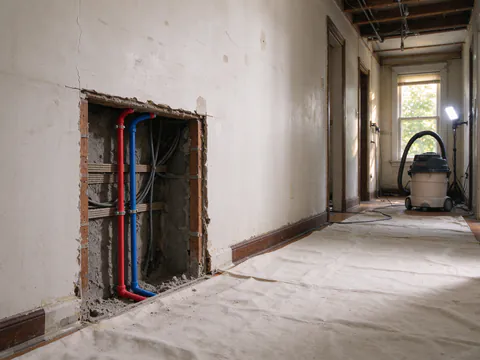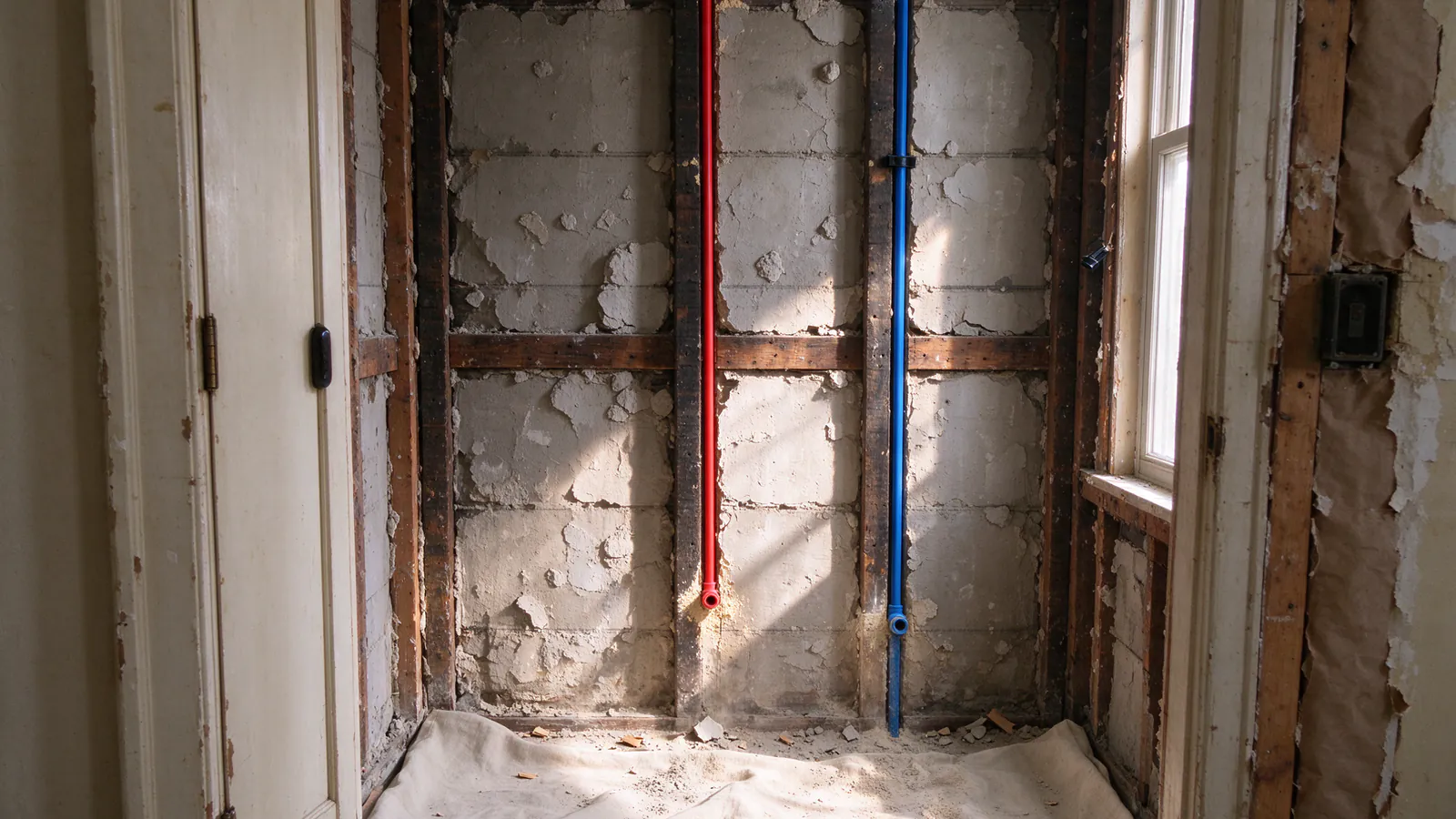
There is no standard number of days for a repipe. The time depends on how many floors and fixtures the house has, how easy the routes are, how much plaster has to be opened and closed, and when the L&I inspection can be scheduled. What can be planned is how long the water is off, and with good staging that is a set of short, scheduled windows rather than days without water.
Philadelphia Freedom Repipe replaces the water supply piping in occupied houses across Philadelphia and nearby Delaware, Montgomery and Bucks County suburbs. Most people stay in the house during the work. This guide explains what sets the schedule, how water-off time is kept short, and how to prepare, so the whole-house repiping quote you get can be read against your own routines.
What sets the length of a repipe
A repipe has three kinds of time in it, and only one of them is pipe work.
Installation time grows with the number of fixtures, the number of floors the risers climb and the difficulty of the routes. A two-story rowhouse with open basement joists, a kitchen at the back and one bathroom above it is about as simple as a whole-house job gets. A three-story twin with two bathrooms, a rear addition over a crawlspace and plaster on every floor takes longer for the same reasons it costs more; the repiping cost guide lists those drivers.
Waiting time sits between stages. The new piping has to be pressure tested, and where the permit calls for an inspection before walls close, the openings stay open until that happens. The Philadelphia repipe permit guide covers how the permit and inspection work.
Restoration time is the plaster. Patching plaster in layers means letting each coat set before the next goes on, so a finished-and-painted patch scope adds days that a rough-close scope does not. The plaster walls guide explains the three patch tiers.
Ask for a schedule that separates these, so you know which days involve open walls, which involve water-off windows and which are just waiting.
How the water-off time is kept short
The usual approach is to build the new system alongside the old one. The old galvanized or copper keeps supplying the house while the new mains are hung in the basement and new risers go up through closets and chases. Nothing is disconnected until the new section is ready to take over.
Then comes a cutover. The water is shut off at the main shutoff, the old section is cut and capped, the new section is connected, and the water comes back on. A cutover can be one fixture group, one floor or the whole house at once, depending on how the job is staged. Staging the job floor by floor means more cutovers and temporary transitions between old and new pipe, which can lengthen the job, but each water-off window is smaller.
If the main shutoff itself is old, seized or a globe valve that will not close fully, it may need replacing first, and that requires the curb stop outside to be closed. In Philadelphia the curb stop belongs to the property owner, and one that will not turn can hold up the start. The curb stop guide explains what happens then.
After each cutover, the new lines are flushed. Scale knocked loose from old valves can travel to the first faucet downstream, so aerators and fixture screens are cleaned, and water may run cloudy or discolored briefly while air and debris clear.
Staying in the house: what a normal day looks like
On a typical work day in an occupied house, expect noise from cutting and drilling, a sealed-off work area or two, drop cloths on the route from the front door, and people going up and down to the basement. Water is usually on except during announced windows. Sleeping rooms can be left untouched until their own walls are reached.
A few households find it easier to be elsewhere for part of the job: someone working from home who needs quiet on a cutover day, a newborn, or a person sensitive to dust. That is a choice about comfort, not a requirement of the work. If someone in the house depends on water for medical equipment, say so at the walk-through so the windows can be planned around it.
What to prepare before day one
- Clear the routes. Empty the closets and base cabinets marked as pipe routes, pull furniture away from marked walls, and take down pictures and shelves near openings.
- Open the basement. The meter, main shutoff, water heater and basement joists all need to be reached. Move stored boxes away from the front wall and the path to the back of the house.
- Plan for water-off windows. Fill a few jugs before each window, run the dishwasher and laundry beforehand, and know which bathroom is in service.
- Protect what matters. Valuables, fragile items and anything that should not collect dust go into a closed room the work will not reach.
- Pets and children. Open walls, cut pipe and tools on the floor are hazards; keep pets and small children out of the work areas.
- Tell the neighbors if needed. In a rowhouse, cutting and drilling carry through the party wall. The work stays on your side, since Philadelphia’s code does not let water distribution pipe cross adjoining property lines, but a word next door before a loud day helps.
When the service line is part of the plan
If the water service line from the street is lead or galvanized, replacing it is separate work with its own permit, sidewalk opening and curb stop. Doing it before or alongside the repipe means the new interior piping starts from a new main shutoff. The Philadelphia Water Department describes its pilot program replacements as usually taking one day, between four and eight hours, but that figure is for the service line alone. The lead service line replacement page covers that scope.
What the written plan should include
Before the first day, ask for: the order of the stages, the planned water-off windows, which bathroom stays in service, which walls open in which stage, when the pressure test and inspection fall, and when each opening closes and to what finish. Philadelphia Freedom Repipe’s process ends with labeled shutoffs and a written list of openings and who closes each one. If you rent the house out rather than living in it, the guide to repiping a rental property covers staging around residents, and the do I need a repipe check helps decide whether the job is needed at all.