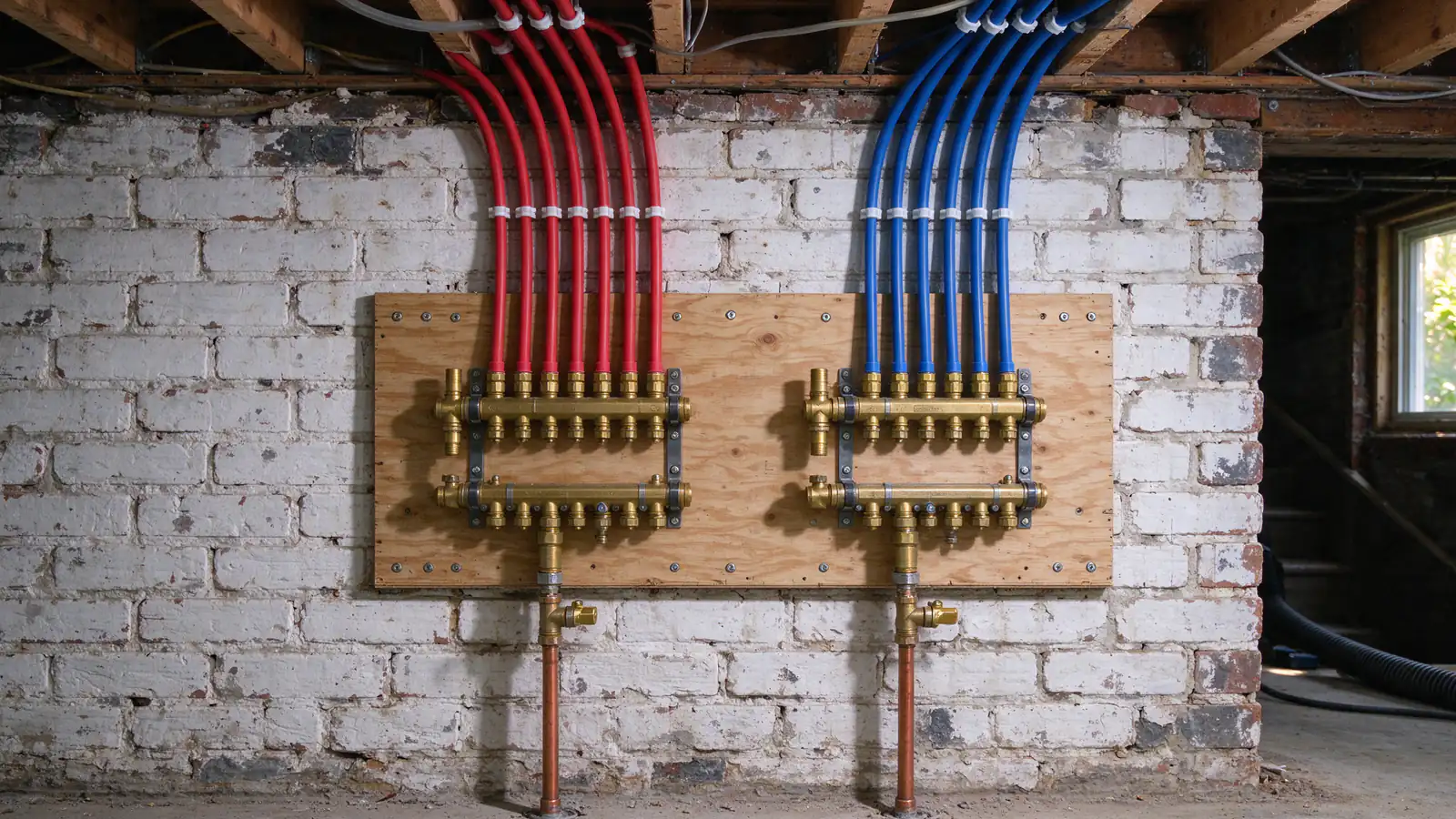
Philadelphia administers its own plumbing code, and the version that governs a repipe today is the 2018 Philadelphia Plumbing Code with amendments in effect since April 1, 2024. A bill to adopt the 2021 International Plumbing Code as the city’s plumbing code, Bill No. 250645, was introduced on June 12, 2025; whether it has been enacted is something to confirm with L&I, which publishes the code in force. Outside the city, Pennsylvania’s statewide code moved to the 2021 International Plumbing Code effective January 1, 2026.
For anyone planning a repipe, the practical questions are which pipe the code allows for the building, what has to be metal, and who can do the work. This post sets out what is in force, what is pending and how the suburbs differ. Philadelphia Freedom Repipe replaces water supply piping in Philadelphia and nearby suburbs, and the PEX repiping page covers the material choice in practice.
What is in force in Philadelphia
The 2018 Philadelphia Plumbing Code, Title 4, Subcode P, is “predicated upon the 2018 International Plumbing Code with local modifications.” It was signed on July 24, 2019, took effect on October 1, 2019 and became mandatory for all applications from April 1, 2020, according to L&I’s implementation bulletin. Amendments took effect on April 1, 2024, and L&I’s summary of the amendments lists the sections that matter most for a repipe.
Pipe material by occupancy. Section P-605.4 says any water supply piping “supplying or located within occupancies other than one- and two-family dwellings and apartments shall be metallic piping.” P-605.3 says the same for water service pipe. In practice, a rowhouse, twin or apartment can be repiped in PEX or copper, while a corner property with a store on the ground floor needs metallic pipe for the commercial part. The guide to whether PEX is allowed in Philadelphia works through examples.
Tall buildings. P-605.4.1 requires metallic piping in buildings with an occupied floor more than 75 feet above fire-access level, with an exception for nonmetallic pipe inside individual dwelling units in new construction between 75 and 150 feet.
Joints and connectors. Press-connect and push-fit joints are allowed above ground only. Flexible water connectors are prohibited except in one- and two-family dwellings and apartments, where they must meet ASME A112.18.6 and stay accessible.
Underground and entry pipe. Underground or outside water distribution pipe must be rated for at least 160 psi, and materials not rated for water distribution must stop at the full-open valve where the pipe enters the building.
Property lines. P-603.3 says water distribution pipes may not cross adjoining property lines, and P-602.1.1 requires each building on a street with a main to have its own connection to the public main. For rowhouses, that means new pipe stays inside your own walls; the rowhouse repiping page explains how.
L&I’s EZ permit standards add details that apply to repipes in smaller buildings, including at least 4 feet of copper or similar metallic pipe at the water heater’s inlet and outlet, thermal expansion control where a pressure-reducing valve, check valve or backflow assembly is on the incoming supply, and R-3 insulation on hot water pipe in several situations.
What is pending: Bill No. 250645
Bill No. 250645, introduced June 12, 2025, would adopt the 2021 International Plumbing Code as the Philadelphia Plumbing Code with local amendments. For water supply piping, the introduced text:
- keeps the metallic-piping requirement for occupancies other than one- and two-family dwellings and apartments (P-605.3 and P-605.4);
- keeps the 75-foot high-rise rule (P-605.4.1);
- adds that “Pipes 3 inches and larger shall be ductile iron to the meter.”
L&I’s FAQ on significant changes in the 2021 International Plumbing Code, published in September 2025, described the local changes as “pending legislative adoption.” The bill’s enactment and effective date were not confirmed. Until L&I announces an effective date, plan a repipe to the code in force, and check whether a transition period applies before a permit application is filed. For most house repipes, the bill as introduced would not change the material choice; the ductile iron line concerns pipe 3 inches and larger, while L&I service line permits mostly specify 3/4-inch lines.
A companion bill to adopt the 2021 International Residential Code, Bill No. 260395, was introduced on April 23, 2026. Its proposed climatic table lists a 30-inch frost line depth for Philadelphia. That bill’s status was not confirmed either.
What the suburbs enforce
Townships and boroughs in Montgomery, Delaware and Bucks counties follow the Pennsylvania Uniform Construction Code. Its rules, published in the Pennsylvania Bulletin on November 8, 2025, adopt the 2021 International Plumbing Code in its entirety except for accessibility provisions, effective January 1, 2026. Philadelphia’s local occupancy rule for metallic pipe is not part of that code.
Each township or borough’s own permit and contractor rules apply. Upper Darby, for example, requires a permit before installing or modifying water supply or distribution piping and limits who may apply, and Abington requires applications to come from a master plumber or journeyman registered with the township. The Upper Darby and Cheltenham pages cover local details.
The federal rule in the background
The plumbing code governs pipe inside the property. The service line from the street is shaped by a separate federal rule. The EPA’s Lead and Copper Rule Improvements, issued October 8, 2024, require water systems to identify and replace lead pipes within 10 years. PWD summarizes its obligation as replacing all lead and galvanized service lines within 10 years, starting 2027. That rule does not require interior repiping, but it is why service line programs are expanding; the lead service line replacement page explains the owner’s side.
What this means for a repipe now
- Material: PEX or copper in one- and two-family dwellings and apartments; metallic pipe in other occupancies and in tall buildings.
- Water heater: a metallic section at the inlet and outlet under the EZ standards.
- Permit: an L&I permit with a licensed master plumber overseeing the work; the Philadelphia repipe permit guide and the guide to who can do plumbing work in Philadelphia cover both.
- Pending changes: none confirmed that would change a typical house repipe.