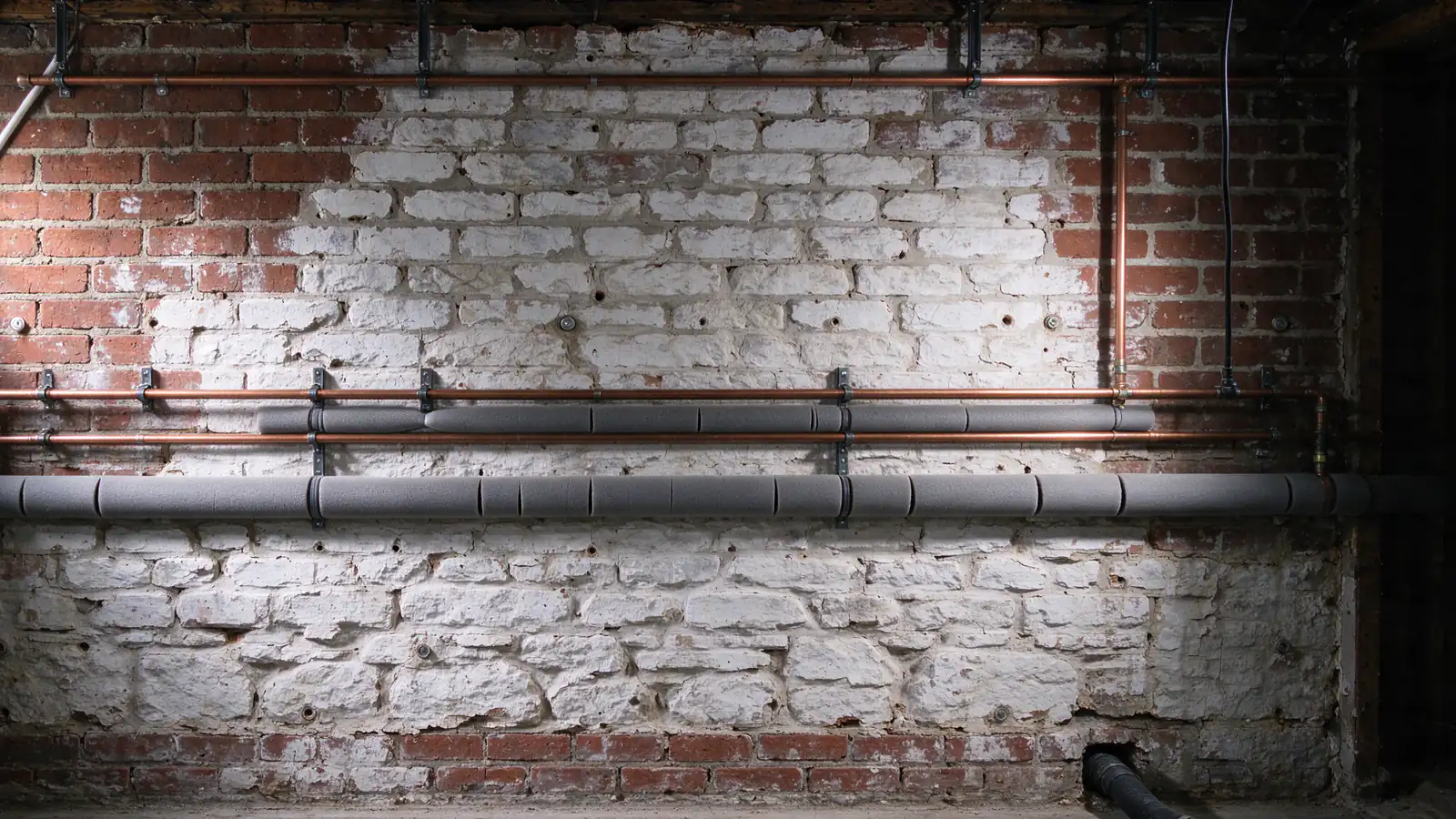
Pipes freeze in a Philadelphia rowhouse where water lines run outside the warm core of the house: at the front foundation wall, in a rear addition, at the top floor and on any exposed outside wall. The city sees enough cold to make that matter. By NOAA’s 1991 to 2020 normals for Philadelphia International Airport, the average January low is 26.0°F, and the city averages 77.3 days a year with a minimum at or below freezing and 13.1 days a year when the temperature never climbs above it.
A repipe can move pipe out of those cold spots and add the shutoffs that limit damage. It cannot make any pipe freeze-proof. This post explains where rowhouse pipes are exposed, what to do before the first hard freeze, and what new piping changes. Philadelphia Freedom Repipe replaces water supply piping in Philadelphia rowhouses, and the rowhouse repiping page covers how those houses are laid out.
Why the cold finds rowhouse pipes
A rowhouse in the middle of a block has one advantage: its neighbors’ heat warms the party walls on both sides. The cold comes in at the front and back, through the roof and, in an end-of-row house, through the exposed side wall. The water pipes that run along those surfaces are the ones at risk.
The front foundation wall. In many Philadelphia rowhouses the service line comes through the front foundation wall to the meter and main shutoff in the basement. That wall is cold masonry, often partly below grade, and the gap where the pipe passes through can let outside air in. A meter tucked tight against it in an unheated corner of the basement is a classic freeze spot. The Philadelphia curb stop guide explains how to shut water off outside if the meter area freezes and leaks.
The rear addition. Many rowhouses have a kitchen or laundry in a one-story addition at the back, often over a shallow crawlspace rather than the main basement. Supply lines run across that cold floor framing to reach the sink or washer, sometimes along an outside wall.
The top floor. A third-floor bathroom or a second-floor bath under a flat roof can have supply lines in a cold ceiling or an outside wall, with little insulation between them and the roof deck.
The hose bibb. A faucet on the back wall has water sitting in the short section of pipe that passes through the wall. Without an indoor shutoff, that section freezes first.
How a frozen pipe actually bursts
Ice expanding inside the pipe is only part of the story. When a section freezes solid, the water trapped between the ice and a closed faucet has nowhere to go. As more ice forms, pressure in that trapped section rises until the pipe gives, often some distance from the ice itself. That is why a split can turn up in a warm-looking spot near a fixture, and why it often shows only when the ice thaws and water starts flowing again.
Old galvanized steel is especially vulnerable at its threaded joints, which are already its thinnest points. Copper tends to split along its length. PEX can stretch a little, so it is more forgiving, but its fittings and valves can still fail; the PEX vs copper repipe guide weighs the two.
Before the first hard freeze
- Find and test the main shutoff. Know where it is, and make sure it turns. An old valve that will not close is worth replacing before winter, not during a burst; the main water shutoff replacement page explains that job.
- Close and drain the hose bibb. Shut its indoor valve, open the outside faucet and leave it open, and disconnect the hose.
- Seal the front-wall penetration. Close gaps around the service pipe where it enters the basement, and keep the meter corner from being walled off from the basement’s heat.
- Insulate exposed runs. Foam pipe sleeves on lines in a crawlspace, an unheated basement corner or a cold ceiling help, though they slow heat loss rather than stop it.
- Keep heat moving. On the coldest nights, open the doors of sink cabinets on outside walls and keep the thermostat steady, including when the house is empty.
- Plan for a trip away. If you leave for days, keep the heat on and consider closing the main shutoff, so a split cannot run for long.
If a pipe does freeze, thaw it gently with warm air, starting near the open faucet, and never with an open flame. Be ready to close the main shutoff the moment water appears.
What a repipe can change
A repipe replaces the supply piping, so it is a chance to move pipe out of the cold rather than replace it in the same place. In a rowhouse, that means:
- Routing inside heated space. New lines can run along interior walls and through heated floors and closets instead of along an outside wall or across a cold addition floor. Where a run has to pass a cold surface, it can be kept on the warm side of the insulation.
- Insulation where required and where wise. Philadelphia’s EZ permit standards call for R-3 insulation on hot water pipe in several cases, including runs outside conditioned space. Cold lines in the same spaces benefit from it too.
- Shutoffs that let you isolate the cold spots. A labeled valve on the branch to a rear addition or a hose bibb lets you drain that run for winter or shut it off after a split, without shutting down the house.
- A working main shutoff. Replacing a seized main shutoff as part of the job makes every future freeze easier to handle.
The guide to old water pipes in Philadelphia homes explains how to tell what you have now, and the whole-house repiping page covers the full scope.
What a repipe cannot change
New pipe in the same cold place freezes like old pipe. No material is freeze-proof, and a repipe does not change how well the walls, roof or crawlspace are insulated. It also does not touch the water service line from the street, which runs underground; that line’s depth and condition are a separate question, covered on the lead service line replacement page. For reference, the climatic table in the proposed Philadelphia adoption of the 2021 residential code lists a 30-inch frost line depth; that bill’s enactment was not confirmed.
If winter keeps finding the same pipe, the useful fix is moving that run, not just replacing it. The living through a repipe guide explains what that work involves while the house stays occupied.